


All articles
Sorted by published date
JFK: Why he matters still…
By Beryl Wajsman on November 27, 2014
 Today is the fifty-first anniversary of the funeral of John Fitzgerald Kennedy, 35th President of the United States. Just over a half-century after his assassination, his hold on our imagination does not wane. It is important to reflect on the reasons why.
We live in a petty era colored by false pieties, moral relativism and obsequious pandering to the lowest common denominator. JFK matters to us still because he made courage tenable. Courage to be just. Courage to be compassionate. Courage to be dreamers. And he challenged all our resolves to make it so.
L’Iran se moque des Occidentaux
By Amb. Freddy Eytan on November 27, 2014
 La prolongation des discussions avec l’Iran est sans doute préférable à un échec cuisant des pourparlers ou à la signature d’un mauvais accord. Cependant, tant qu’il n’y aura pas de traité crédible et définitif les occidentaux ne peuvent se réjouir et devraient au contraire être plus vigilants et intransigeants. Il faut reconnaître que dans la récente bataille diplomatique sur la suspension des sanctions et l’avenir du projet nucléaire, les Ayatollahs ont brouillé les cartes et dicté l’ordre du jour. Ils sourient ironiquement, enchantés de marquer des points. Ils peuvent enfin se frotter les mains avec satisfaction. Ils prouvent aux Occidentaux que dans le bazar oriental ils demeurent orfèvres en la matière.
La terreur islamiste à Jérusalem
By Amb. Freddy Eytan on November 19, 2014
Le dernier massacre contre les fidèles de la synagogue Kéhilat Yaacov à Jérusalem s’inscrit dans une série d’attentats sanglants qui ont débuté depuis plusieurs années. Quatre rabbins ont été tués avec leurs châles et livres de prières, assassinés au couteau et à la hache comme du bétail. Des images horribles qui rappellent des souvenirs lointains ceux des pogroms en Europe. Les condamnations unanimes à travers le monde sont réconfortantes mais ne peuvent en aucun cas entendues seulement après chaque attentat meurtrier. La communauté internationale devrait prendre des mesures préventives, être plus énergique face au fléau du terrorisme et elle doit le combattre sans pitié et sans distinction. Nous devons tous dénoncer le terrorisme islamique qui déferle à travers tous les continents.
Zombie shoptalk: Margaret Atwood on the undead and why she loves Twitter
By Stephanie Azran on November 18, 2014
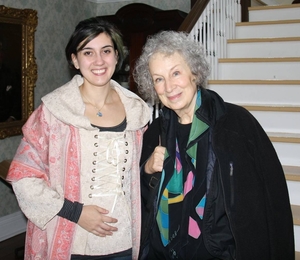 Margaret Atwood knows how to work a room- so long as the room is in darkness and the spotlight is on her. That's just what she did at a recent reading in Hudson, leaving the audience enthralled with her performance of the first few paragraphs from one of her short stories.
Atwood recently appeared at Greenwood's StoryFest, a literary festival celebrating Canadian authours. The grand dame of Canadian literature was a major score for the Greenwood folk, who have also welcomed Michael Ondaatje, Romeo Dallaire and Atwood's husband Graeme Gibson.
Memo to Premier Couillard: We elected you to stop this!
By Beryl Wajsman on November 18, 2014
We yearn for investors from outside Quebec to invest here. We know that foreign investment is critical to job creation and to increased bank credits for small business. So forgive our astonishment at last week's news that the websites of international retailers
Williams-Sonoma, Urban Outfitters, and Club Monaco had been blocked in Quebec because...you guessed..they didn't comply with the language laws! After the Marois legacy of Pastagate and all the other little "gates" we expected this government to stop the madness and reign in the OQLF. Apparently it needs another memo.
'Ich bin immer noch ein Berliner'
By Robert Frank on November 13, 2014
 For the generation that has grown to adulthood in the 25 years since the Berlin Wall fell, it must be hard to fathom how profoundly the world changed on Nov. 9, 1989.
We stared in wonderment at the television images of young Berliners from both East and West standing and singing arm-in-arm atop the divide that had defined the world we had grown up in.
“Wir sind das Volk,” read their banners. We are the people.
It was completely unexpected.
Until that day, many Western political pundits told us that the authoritarian Soviet Union would be around for another century. They asserted that we ought to find a way to accommodate the now defunct superpower. Unilateral disarmament by the West was mooted as a panacea.
The Unforgotten War
By Robert Presser on November 13, 2014
 As we approached the 100th anniversary of the First World War, there was a conscientious effort among governments and academics to revisit the causes of that war and reflect on the lessons of its aftermath. Unlike the Second World War, there are no more witnesses alive to recount their recollections, no longer do veterans of the Great War march in Remembrance Day processions. One hundred years on, history is making a U-turn to explore the echo of WWI, the unforgotten war.
I call it the unforgotten war because for at least a half-century its memory was suppressed by the shadow of WWII. How did that come to pass?
Trudeau's suspension of MPs shows lack of judgement
By Jordan Turner on November 11, 2014
 Last week, Canadian Liberal Leader Justin Trudeau announced the suspension of two Liberal Members of Parliament (MP), Scott Andrews and Massimo Pacetti, of his party caucus over allegations of harassment made by two other MP’s from the opposing New Democratic Party (NDP). The accusations of harassment were made in a private conversation with Justin Trudeau and were not meant to go public. NDP party whip Turmel was aware of the accusations of misconduct and the alleged victims clearly stated that they did not wish to file formal complaints as they did not want to destroy the political careers of the liberal MP’s being accused of harassment. However, Trudeau in yet another example of his complete lack of judgement publicized the harassment allegations and suspended his MP’s prior to any investigations.
A Lost Boy In Winnipeg
By Alan Hustak on November 9, 2014
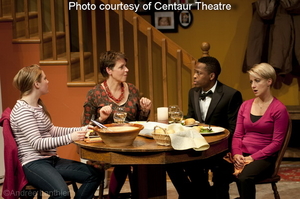 Social Studies, Tricia Cooper’s intriguing play at the Centaur until Nov. 30. is an ultimately sad and fragmented socio-political comedy about a young Sudanese boy who has been transplanted from war torn Africa to a comfortable suburban Winnipeg neighbourhood. Most of the laughs in the play, however, derive from cultural misunderstandings rather than genuine comic dialogue. The evening opens with a self-centered character, Jackie, (Eleanor Noble) running back home to her mother after a failed marriage, only to be told by her younger sister, Sarah (Emily Tognet) that her old room is taken.
Bingo! Les Belles Soeurs wins as a musical.
By Alan Hustak on October 30, 2014
 It was St. Therese of Avila who said that more tears are shed over answered prayers than there are over unanswered ones. That’s pretty much the point behind Michel Tremblay’s classic play Les Belles Soeurs, The play focuses on Quebec housewife, Germaine Lauzon who wins a million trading stamps then invites her friends and neighbours over to share her good fortune with devastating consequences.
Tremblay has seen his play done so many times and so many ways he appears to have distanced himself from the work. But he was around for the opening at the Segal Centre of the English language premiere of the musical based on the original.
"One language, one culture?" M. Fournier, an explanation is owed.
By Beryl Wajsman on October 30, 2014
"The Quebec of the future is already visible. A nation within a federation. With one language, one culture, civil law, and distinct social values."
With those words, the Couillard government's Minister for Intergovernmental affairs and the MNA for St.Laurent - one of Quebec's most multilingual and multicultural ridings. - Jean-Marc Fournier reopened a debate we all thought was closed with the election of a Liberal government. "One language, one culture." Really? M. Fournier, you owe voters an explanation.
Liberty demands responsibility Time to stop excusing the enemies within.
By Beryl Wajsman on October 30, 2014
"Liberty demands responsibility. That's why so many dread it." George Bernard Shaw wrote those words at a time when the rising tide of fascism was a clear menace, yet so many in western nations felt compelled to excuse and appease. It was they - free citizens - who were afraid of the responsibility that comes with freedom.
I share these words today, because if there is one living testament that can be made to the ultimate sacrifices of Warrant Officer Patrice Vincent and Corporal Nathan Cirillo it is that we - their fellow Canadians whom they served and protected - must understand that it is our responsibility to fight back in civil society against the purveyors and perpetrators of this era's theocratic fascism.
What Are You Doing Sunday?
By Joel Ceausu on October 30, 2014
 You’ve read the headlines. Here, in other papers, saw TV reports and heard it on the radio.
You get it; the game is stacked against English participation in school board elections. Unless you have a kid in English school, you should never have assumed you have the right to vote for English boards, because for years the English boards have been double-teamed: Names summarily yanked off English rolls by an electoral system designed to minimize the Anglo franchise, while language laws choke off enrolment.
Nice talk of collaboration, lobbying and consultations has not amounted to a hill of beans over the years. That’s not my opinion:
Twisted Two Hander: Venus In Fur Is Terrific
By Alan Hustak on October 19, 2014
 Venus in Fur, the emotionally sordid, sadomasochistic romp at the Centaur until Nov 9 is not only harrowingly funny, but it keeps us on our toes. The subject is sexual tension - sexual confusion and erotic role playing - it delves into the darkest recesses of sexual fulfillment. It helps to know that the play by David Ives is based on Leopold von Sacher-Masoch’s 1869 novel of the same name. (He lent his name to the term masochism).
It’s a wholly theatrical play, a two hander which explores fetishes and fantasies and depends on raunchy actorly artifice.
Corinne Kernan Sevigny 1924-2014
By Alan Hustak on October 4, 2014
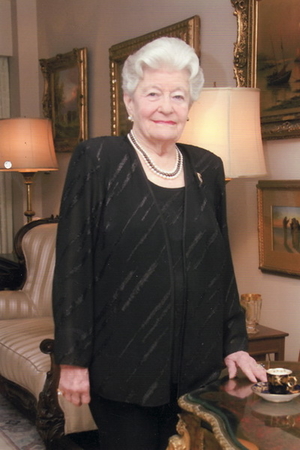 Corinne Sevigny, who died Friday, at the age of 90, was an indomitable character who was connected to pedigreed political families in both Canada and the United States. Her paternal grandfather, Francis Kernan was the first Roman Catholic to be elected to the United States Senate. Her maternal grandfather, Sir Charles Fitzpatrick, was a former Quebec lieutenant governor and one of Louis Riel`s defence lawyers. Raised in an atmosphere of privilege, she was a no-nonsense, powerhouse of a woman, who in the words of one friend, “is now in heaven, undoubtedly telling the angels what to do and how to do it.”
Want to stop ISIL? Kill the money trail!
By Robert Presser on September 29, 2014
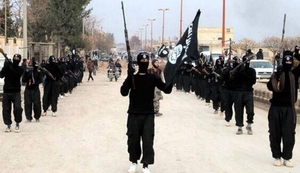 A remarkable event occurred during the week of September 22nd 2014 – the US and Arab-nation coalition against ISIL attacked the Islamic fundamentalist group’s oil assets in northern Iraq and southern Syria. Long considered off-limits under the hopes that legitimate governments would reassert control over these locations, this is the first overt attempt at cutting off the flow of profits from low-priced ($30 per barrel) oil sales used to finance the nascent caliphate’s terrorist activities. This overt undertaking is a tacit admission that neither a legitimate Iraqi nor a non-Assad Syrian coalition are likely to re-take these assets in the short or medium-term, so preserving their integrity is to be sacrificed for the greater goal of crippling ISIL’s finances. While this is just a first step, it represents a critical tactical change in the War on Terror, now in its second decade.
Taxes And Dual Citizenship
By David T. Jones on September 14, 2014
 Washington, DC - Everybody despises taxes. The standard lament is “Nothing is inevitable but death and taxes.”
At best taxpayers put a good face on the process, accepting that taxes are a necessary element of civilization. At a minimum, virtually all agree that we require taxes for security from foreign invasion and to protect against home invasion. On a national and local level, security is an accepted use of taxes.
Other than security, however, there is endless argument regarding whether a service or benefit (education, health, postal delivery, water purification, disease eradication, transportation, infrastructure) should be paid by government taxes or private funding.
The Absurdity of the United Nations Human Rights Council
By Jordan Turner on September 14, 2014
As the dust settles in the current round of fighting between Israel and Hamas following the latest cease-fire, Israel prepares for a new battle on the legal and diplomatic front. It has now become a unique custom that all of Israel’s wars and operations be subject to international investigation and review by the United Nations Human Rights Council (HRC). It was no surprise that on July 23rd, 2014 the HRC passed a resolution sponsored by some of the worst human rights violators, to form an inquiry into Israel’s conduct in its latest war with Hamas.
Graduate with a Hard Edge.
By Alan Hustak on September 10, 2014
 As Mrs. Robinson, the predatory cougar in the Segal Centre’s coarse, hard-edged and erratic stage adaptation of The Graduate running until Sept. 21, Brigitte Robinson glows like tip of her smoldering, ever- present cigarette. The overall production of the 1967 cinema classic, however, has lost something in the transformation from the screen to the stage. The play has all of the substance and none of the charm of the original. It gets off to a promising start as Mrs. Robinson seduces Benjamin Braddock, the 20-year old misfit hero (Luke Humphrey.) within the first ten minutes.
A word on the Constitution
By Beryl Wajsman on September 8, 2014
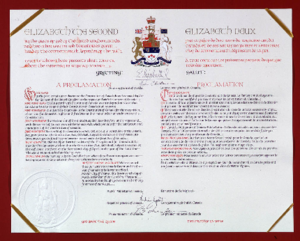 Urban legends are not relegated to second-rate movies or the twittersphere. Too often even elected officials and members of the fourth estate succumb to the easy story line. Whether it is because some really don't understand an issue or because they are wedded to the notion that a "six second sound bite" is all anyone can absorb, they perpetuate realities that are simply wrong. As Daniel Patrick Moynihan once quipped, "Everyone is entitled to their own opinion but not to their own facts."
Here in Quebec, every time the word "Constitution" is mentioned it is always around the issue that this province is not a signatory to Canada's central governing piece of legislation. That is simply false. We are in this debate once more since Premier Couillard mentioned several days ago that it would be appropriate if Quebec "signed" on by 2017, the 150th anniversary of Confederation.
Canadians In Dreamland
By David T. Jones on September 7, 2014
Washington, DV - An observer of things Canadians in the Southland looks upon the Trudeau home break-in incident with puzzled, indeed appalled disbelief. Canadian failure to appropriately guard its officials literally begs for tragedy.
Justin Trudeau, Liberal Party leader, is arguably the second most important individual in Canada. .He is the emergent figure in Canada's political landscape! but in Quebec “you either love him or hate him” as one Quebecois noted.
Yet his family residence was so unguarded that the front door wasn’t even locked.
A Brief History Of Modern Inflation
By Robert Presser on August 31, 2014
Canadian consumer debt remains a concern to policymakers in government and at the BofC, and our real estate prices enjoy high single digit price increases year over year, which would not be possible without the generous variable rate mortgages the banks continue to hand out. Should you be worried or care about mounting debts in Canada? The answer is yes, since eventually either interest rates will rise to levels that the debtors cannot afford, inflation will re-ignite to destroy the value of your savings, or perhaps both, last seen in the late 1970s.
Taking the D out of BDS
By Jordan Turner on August 29, 2014
With universities worldwide about to begin the new semester we are about to see a surge, as never seen before, for the BDS (Boycott, Divest and Sanction) anti-Israel movement on university campuses. The rhetoric, protests, demonstrations and intimidation of Jews, and of those whom believe in Israel’s right to exist, will be rampant. Just this past week in Canada the Ontario branch of the Canadian Federation of Students representing over 300, 000 university students have unanimously passed a motion to boycott Israel. This was preceded by Ryerson University’s student union voting last April to boycott Israel. These boycotts are only the start of what will be a well-organized push to delegitimize Israel and its supporters.
U.S. FOREIGN POLICY: IT PIVOTS—BUT DOES IT STAND?
By David T. Jones on August 20, 2014
Washington DC…U.S. foreign policy is (Select one of more of the following: adrift; unfocused; contradictory; confused; disheartening; disconcerting; wrong-headed).
In a concerted issue to be anti-Bush, President Obama and his Administration have spent almost six years attempting to create a working, understandable, coherent foreign policy. In so doing, they have:
-- Announced “reset” of policy toward Russia, without really saying what was wrong with the previous policy other than Dubya Bush pursued it. And then they have found themselves confronting a bear whose aggression annexed Crimea and appears intent on destabilizing the rest of Ukraine;
Taxes surpass housing as main family expense
By Joel Ceausu on August 20, 2014
 If you are an average Canadian family, you need not worry anymore about government picking your pocket: you now need to be concerned about your pockets.
“If you asked people to name their household’s biggest expense, many would likely say housing,” says Charles Lammam, co-author of the Fraser Institute’s Canadian Consumer Tax Index. “In reality the average Canadian family spends more on taxes than all basic necessities, including housing.”The study found that the average Canadian family earned $77,381 and paid almost 42 percent – $32,369 – in total taxes, compared to 36.1 percent for food, shelter and clothing combined.
Robin, "we hardly knew ye..."
By Beryl Wajsman on August 13, 2014
If he couldn't make it, who could? If he couldn't conquer the demons, how are we to cope? As much as his art touched the millions that loved him, these questions also explain why Robin Williams' suicide touches us all so poignantly.
Williams' battles with depression and substance abuse are well-known. But one does not have to be clinically depressed to empathize with the everyday demons so magnified in illness that Robin succumbed to. We all have them, and constantly battle them.
On appearances
By Father John Walsh on August 10, 2014
 Do clothes make the woman or the man? There are shocking and staggering fashion industry statistics. There are over 7 billion people on this planet. If you count one number a second without stopping until you reach a billion, you’d be counting for 31 years, 259 days, 1 hours, 46minutes, and 40 seconds. If each person owned only one pair of pants, one shirt, and one jacket, that would be 21 billion articles of clothing. If you were to count each of those, one per second, it would take nearly 672 years. We spend more than a few dollars to keep up our appearance.
La diplomatie américaine est naïve et irréfléchie
By Amb. Freddy Eytan on July 30, 2014
Jérusalem, Israël. Les images en provenance de Gaza sont horribles et très dures à voir. Comment être indifférent à ce gigantesque enchevêtrement, à ce chantier de ruines humaines, au désastre, et à la tragédie des familles palestiniennes. Toutes les guerres sont terribles et sales et nous déplorons une fois encore les victimes et les dégâts. Cependant, les chancelleries et les médias doivent dire toute la vérité et reconnaître que la faute incombe essentiellement au Hamas qui a provoqué cette guerre.Les chefs du Hamas ont cru transformer Tel-Aviv et les villes israéliennes en champ de bataille et en ruine par un lancement massif de roquettes et de missiles, et par des méga-attentats terroristes contre des villages et kibboutzim israéliens situés le long de la frontière.
Le vrai visage du Hamas et notre juste cause
By Amb. Freddy Eytan on July 22, 2014
Jérusalem, Israel - La guerre que nous menons ces jours-ci contre le Hamas a été lancée à contre cœur. Elle nous a été imposée. Il faut savoir que les Israéliens ont ras le bol des guerres et souhaitent ardemment vivre en paix et en coexistence avec nos voisins arabes. Nous sacrifions chaque jour nos propres soldats, nos propres enfants, pour défendre notre pays, nos maisons et nos foyers. Les faubourgs de Gaza ne sont pas des banlieues paisibles. Le quartier de Sajajjihé où se déroule des combats acharnés ne se trouve pas à Neuilly ni à Manhattan… C’est un bastion terroriste du Hamas ! C’est delà que partent les tunnels et d’ici sont lancées les roquettes et les missiles sur les villes et villages d’Israël.
OMAR KHADR: THE LUCKIEST MAN IN THE WORLD
By David T. Jones on July 18, 2014
Washington, DC - Canadians are now being treated to the latest episode in the long-running Omar Khadr sob story. An Alberta appeals court has ruled (but the federal government plans to appeal) that Khadr should be transferred from a federal penitentiary to a provincial prison.
The technical argument is that the eight-year sentence imposed on Khadr after he pleaded guilty in U.S. court to five crimes, including murder, was a youth sentence in Canadian terms. Of course, nothing of the like was indicated in the U.S. disposition of the sentence. Indeed, his repatriation to Canada was implicitly dependent on Khadr serving his full sentence under conditions equivalent to those in the United States—not in a county court house jail/motel equivalent with early release. But Canadian disinterest in U.S. juridical practice is legendary.
No proportionality
By Beryl Wajsman on July 14, 2014
Well, now that the only democracy in the Middle East is trying to defend itself, we have the usual calls from some quarters that Israel’s response in Gaza is not proportional. Well, the critics may be right.
It is not proportional that Israel gives notice of targeted bombings while Hamas launches bombs without notice. Israel should perhaps adopt that policy.
No equivalency
By Beryl Wajsman on July 7, 2014
On its own, the murders of the three Israeli Jewish teenagers - Eyal Yifrach, Gilad Shaar and Naftali Frenkel - would call for special condemnation . But what makes this even more urgent, is the rush to moral equivalency in so many quarters in the public arena following the heinous killing of Mohammed Abu Khudair, the Palestinian teenager. If this is the last place, and even the only place, where one truth will be stated clearly and candidly then we must do so. These murders are equally repugnant as individual acts. But there is no collective equivalency between the societies from which they arose.
La vengeance aveugle est contraire aux valeurs du judaïsme
By Amb. Freddy Eytan on July 7, 2014
Jerusalem - Le meurtre horrible du jeune palestinien par des vengeurs juifs est injustifiable et impardonnable. Contrairement aux peuples qui nous entourent, nous savons condamner fermement et arrêter les coupables ! Nous sommes aussi capables d’être solidaires d’une famille palestinienne en deuil. La douleur de la mort d’un enfant n’a pas de frontière.
Cet acte insensé a bouleversé toutes les cartes. Il a apporté de l’eau au moulin à nos détracteurs, a fait verser bêtement et sauvagement de l’huile sur le feu, et a réanimé la haine aveugle et raciste dans un contexte déjà explosif.
The fierce urgency for a guaranteed national income
By Beryl Wajsman on June 30, 2014
The Basic Income Canada Network organized a conference over the weekend at McGill advocating for a guaranteed national income plan. The conference showed the practical path to getting it done. We need to, and can, do this.
The broad principles for a Guaranteed Annual Income were first proposed by Daniel Patrick Moynihan, future UN Ambassador and New York Senator, when he served under President Nixon. They came within a few votes in Congress of getting this done in the early 1970s. A GAI would replace other social security programs such as welfare.
The Normandy Spirit
By John Parisella on June 27, 2014
 Like so many in Canada, the U.S., and Western Europe, I was moved by the commemorative events surrounding the Normandy landing that took place 70 years ago on June 6, 1944. It was a moment to remember the ultimate sacrifice of what journalist Tom Brokaw labeled “the Greatest Generation,” who struggled in the defense of freedom and the elimination of Nazi barbarism. We owe so much to those who fought and to the few veterans remaining. It was a fitting memorial.
In stark contrast to the events surrounding the Normandy landing, a growing controversy in a prisoner-of-war swap soon became the news of the day.


