


All articles
Sorted by published date
Boycott this! Enough is enough!
By Beryl Wajsman on March 16, 2015
 This past Sunday McGill students rejected a motion by their student society - the SSMU - that would have urged the university to boycott Israel and divest investments in companies with Israeli ties. Their action is to their credit and should be applauded. Particularly in light of the fact that last December, Concordia students voted in favour of such a motion.
It is astonishing that students - heavily subsidized students at that - would even be allowed a say in determining academic and investment relations of the institution they attend supported by our tax dollars. Last week we used this space to say "Ça suffit!" to Hydro's gouging. This week we say "enough is enough" of the BDS - boycott, divestment, sanction - crowd.
Mr. Trudeau have you no shame?
By Beryl Wajsman on March 9, 2015
 Justin Trudeau has compared Conservative immigration policies and rhetoric as creating an atmosphere akin to the Liberal government of Mackenzie King's "none is too many" policy against European Jews in World War II. This kind of outrageous demagoguery would disqualify Trudeau from being taken seriously for any office in most western countries.
Aside from the fact that the Harper government just yesterday made clear again it's outreach to Muslims in Jason Kenney's address, there have been no restrictions on Muslim immigration into Canada as there were against Jews. No one is killing Muslims just for being Muslims, as Hitler did to Jews, except for other Muslims like ISIS, Hezbollah, Hamas, Islamic Jihad and Al-Qaeda.
Be Careful, your views could affect your will
By Jordan Turner on March 9, 2015
 Two weeks ago, a story that received limited press should have sent shockwaves throughout the legal establishment and to anyone who has prepared a last will and testament. Ontario, Judge C.A Gilmore rejected the will of the late Rector Emanuel Spence who bequeathed his entire estate to only one of his two daughters as the judge believed his motivations were racist. As such, the Judge set a controversial precedent where the thoughts and views of the deceased, and not the recipient of the inheritance, was determined to be detrimental to public policy and warranted the complete nullification of his will.
Hydro-Québec: "Ça suffit!"
By Beryl Wajsman on March 9, 2015
It is undignified, insulting and misleading for the Quebec Régie de l'énergie to put a positive spin on it's decision to allow Hydro a 2.9% rate increase instead of the asked for 3.9%. The implication that the Board was somehow protecting the public is nonsense. This Board has allowed almost 13% increases over the last three years. Neither inflation, nor the cost of production, nor our incomes have gone up anywhere near that mark. This is simply a hidden tax with one pocket of the government refilling the other pocket of the government. It is time to paraphrase René Levesque when he finished the nationalization of Hydro, as a member of the Lesage government, and say to the utility monopoly, "Ça suffit!"
Point Stories
By Alan Hustak on March 8, 2015
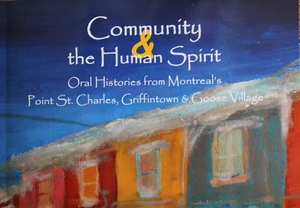 The publishing industry being what it is these days you won’t find a copy of Dave Flavell’s oral history of Griffintown, Point St. Charles and Goose Village in any Montreal bookstore. Newspapers in town have taken no notice of it. But for anyone interested in the social history of Montreal’s storied English-speaking tenement neighbourhoods, his book, Community and the Human Spirit is well worth ordering on line. Like Patricia Burns’ Shamrock and The Shield Which was published ten years ago, Flavell captures a chorus of voices to chronicle a time and place that no longer exists – not just the Irish.
A Wild Night
By Alan Hustak on February 28, 2015
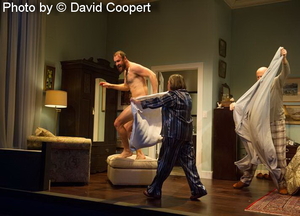 There are home invasions and then there are home invasions.
The Good Night Bird, at The Centaur until March 22 is a preposterous, heterosexual twist on James Kirkwood’s gay comedy, P.S. Your Cat Is Dead. (Yes, there is a role for a dead cat in this show too.) In Colleen Murphy’s screwball version of the Kirkwood tale a mentally unstable, filthy vagrant bent on killing himself hits the balcony of a high rise and winds up, instead, in the bedroom of an emotionally alienated married couple where he breathes new life into their sedentary relationship.
Justin Trudeau just doesn't get it
By Beryl Wajsman on February 18, 2015
Justin Trudeau said yesterday that Prime Minister Harper's insistence that niqabs - female face coverings - should not be allowed in courts and citizenship ceremonies demonstrates an insensitivity to minority rights. I would say that Mr. Trudeau's continuing failure to comprehend that cultural particularities should never be raised to secular right is an overt threat to the health of a liberal pluralistic democracy and is cause for concern in someone who seeks to become the head of government.
New income security coalition unites left and right
By Joel Ceausu on February 16, 2015
 Few things unite the right and left in Canada, Tim Hortons and hockey notwithstanding, but a not-so-radical idea might be one of them.
Mention “guaranteed income” and most people think “handout.” But there’s a lot more to it, says Jonathan Brun, spokesperson for the Basic Income Canada Network and co-founder of Revenue de base Quebec, working to get Canada to adopt a basic income scheme.
“It appeals to everyone because it addresses the burgeoning government bureaucracy and maintains a solid social safety net while changing the way government transfers wealth between taxpayers.”
Doing good is just not good enough!
By P.A. Sévigny on February 16, 2015
 During last week’s hour-long lecture in Westmount’s Atwater Library, Matthew Pearce once again reminded his audience why charity must be more than “...just a soup kitchen and a bed.”
“Shelters were originally conceived as an emergency option and not as permanent housing for the destitute,” said Pearce. “So our goal is not to warehouse people but to help as many as we can to re-integrate back into society. Our ultimate mission is to end homelessness as we know it.”
Time for compassion and coherence in welfare
By Beryl Wajsman on February 16, 2015
The Couillard administration is taking a look at revising welfare. It is in the context of the general austerity plan. It has been made clear that there will be some nominal cuts. This is the wrong policy. It punishes the vulnerable, perpetuates a system that does not work and cannot achieve any economic or social benefits. It is time for compassion and coherence in our welfare policies.
Our social security system – pensions and welfare – have been compromised for generations by governments taking in what were in fact trust monies – deducted from all of us at source - and using them for general purposes.
MIGS director set to fight online terrorism
By P.A. Sévigny on February 16, 2015
As the Senior Deputy Director of MIGS - Montreal’s Institute for Genocide and Human Rights Studies - Kyle Matthews believes that we’re already beginning to fight the Third World War and that its front lines can be easily found on the internet.
Let’s face it,” he said. “…we’re at war, and as of now, the bad guys are winning.”
According to Matthews, western governments should recognize and understand that ISIS – the Islamic State – is already using the social media as an effective medium for all of its propaganda and recruitment efforts and research indicates that they are already getting excellent results.
Earth Angels - Forever Plaid
By Alan Hustak on February 7, 2015
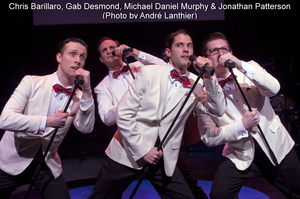 Forever Plaid at the Segal Centre until February 22 is a happy-go-lucky musical museum piece, mounted with obvious affection and encased in clean-cut nostalgia. If the Four Aces, the Four Lads, Johnny Ray, (“The Cry Guy”), Topo Gigo, Senor Wences and Caribbean calypso rhythms mean anything to you, this local production is a faithful, full-fledged hi-fidelty hit.
Stuart Ross’ Forever Plaid made its debut off Broadway 25 years ago, and it remains a crowd pleasure with a certain generation. especially the baby boomers who grew up in an era of 45 r.p.m juke box tunes.
The Mascia judgment: Justice denied
By Beryl Wajsman on February 3, 2015
Justice Salvatore Mascia's judgment in the latest challenge to Bill 101 continued the tradition of avoiding the hard truths that would have necessitated condemning the ugly compromise of justice that has been the hallmark of Quebec law since the passage of this notorious legislation. In so doing he failed a generation and blunted hope. Worse still, he denied natural justice.
I do not use the term "natural justice" pejoratively. It is a term of legal art. It refers to those rights inherent to every human being simply by right of birth. And one of those primordial rights is that all people are to be treated - and seen to be treated - equally before the law. The dignity of the individual has been the litmus test of all civilized systems of law. It is a test Quebec fails time and again.
Online petition demands Hydro rate freeze
By Stephanie Azran on February 3, 2015
 One of the latest petitions to hit activist website change.org is one that could affect the lives of hundreds of thousands of Quebecois and Quebecoises trying to keep warm.
Solene Tanguay, a self-described single mother from the Quebec City area, mounted a petition demanding that Hydro Quebec freeze residential electricity rates.
Since launching, the petition has attracted over 16,000 supporters and Tanguay is looking for almost 10,000 more.
To sign the petition, please visit change.org and search for Hydro-Quebec.
“Counter-productive” Groups denounce welfare reform
By Joel Ceausu on February 3, 2015
“There’s still time,” says Clement Citeya of the Comité des Personnes Assistées Sociales de Pointe-Saint-Charles (CPAS). Still time that is, for the province to reconsider its welfare reforms that the groups calls counter-productive and shows “shocking contempt for welfare recipients and are based on a false understanding of the welfare system.” Quebec is applying its austerity belt cinching to welfare rolls as well, affecting many of the nearly half-million Quebecers receiving social assistance.
CPAS along with Côte-des-Neiges based Project Genesis and other groups held a press conference last week to denounce the changes and Employment Minister François Blais’ “spreading false ideas rather than dealing with real social assistance issues.”
Despite Grandeur, Paris Demonstration Will Fail to Promote Change
By Jordan Turner on January 21, 2015
The media coverage surrounding the biggest march in French History where 1.5 million French citizens and over 40 world leaders marched together to show solidarity for the victims of the massacre at Charlie Hebdo and at a kosher supermarket was unprecedented. The march was portrayed as a momentous event showing support for freedom of expression and free speech which are paramount to a democratic state and gave legitimacy to the old expression that the pen is mightier than the sword. However, despite the sheer numbers at the Paris demonstration, it will go down in history as a missed opportunity and not a turning point in the fight for freedom of expression.
The pen or the Kalashnikov- your choice
By Stephanie Azran on January 18, 2015
Last week, #Je SuisCharlie became the anthem of artists, journalists and citizens who refused to back down in the face of violence.
12 people died in the attacks in Paris and several more French citizens were killed in the days following. In the initial affront, gunmen with Kalashnikovs went into the building during an editorial meeting and opened fire. On writers, editors, citizens of France who may have taken things too far, but for a real purpose.
This isn't the first time the magazine has been under fire- literally. It was firebombed in 2011 for publishing an edition poking fun at Mohammed and Islamic law. Writers and the editor-in-chief were and are used to receiving death threats. Even after requests from the French government to temper their satire, the magazine refused.
Has the West found its inner Charlie?
By Robert Presser on January 18, 2015
 Watching world leaders march in Paris after the attacks at Charlie Hebdo and the Hyper Cachère, I was struck by the opportunistic appearance of the moment. During the very same week, Boko Haram murdered 2,000 people in Baga, Nigeria, no o one organized a march of Western leaders, even from a second tier of available politicos, to express our collective outrage at that massacre. It was left to Canada’s John Baird to make a declaration of condemnation. He was the most senior official within the G8 to do so. It would seem that we treat fundamentalist terrorism in the developing world as an expected event, and there is a lax attitude towards what we can do about it. If we consider Nigeria to be a strategic world asset due to its oil reserves and production capacity, then we should expect BokoHaram’s takeover of vast swaths of the country to galvanize the same response as ISIL’s caliphate in Iraq. Sadly, from a moral or a cynical geopolitical point of view, this is not the case.
Aujourd'hui, nous sommes tous Charlie ... et nous sommes tous juifs
By Beryl Wajsman on January 11, 2015
 Les lombrics se sont glissés hors de leurs repaires une fois de plus dans une attaque brutale et barbare envers la liberté en massacrant des dizaines dans les bureaux de journal français «Charlie Hebdo». Des satires sur l'islamisme et les islamistes constituaient le «crime» du journal. D'ailleurs, il avait été incendié en 2011 pour la republication des caricatures de Mahomet. Ce faisant, ils ont ensuite ciblé des Juifs dans un marché cacher appelé Hyper Cacher. Le «crime» des Juifs était tout simplement d'être juif. Notons toutes les fois où la liberté et les Juifs ont été ciblés pour les mêmes raisons et par les mêmes ennemis.
Time to end our tolerance of the intolerable
By Beryl Wajsman on January 11, 2015
The butchery at Charlie Hebdo and at the Hyper Cacher market in Paris has been called France`s 9/11. And the reason for it is that while America’s 9/11 attacked the world’s centre of commerce, the attacks in Paris violated the world’s historical centre of freedom. These were attacks, co-ordinated attacks, on those who practice freedom of speech and on those who were just born Jews. Two ways of dying under fascism. The two things these terrorists cannot abide. Free speech and free Jews.
I use the word fascism because that is what France’s leading public intellectuals have used. And France, for all its failed appeasing foreign policies, is perhaps the last western nation where public intellectuals do move policy.
Je Suis Charlie
By Father John Walsh on January 8, 2015
 The world must stand up for freedom, freedom of expression; freedom, pure and simple! History has proven that the denial of freedom is the greatest obstacle to our development as human beings. The greatest freedom we have is to seek the truth. Truth will make you free. What is the truth about Je Suis Charlie?
Although we seek truth that is absolute and therefore self-evident, truth is not absolute, it is relative to the events and circumstances in which we seek the truth. It is not situational but must be situated in the time and space in which truth is sought after. In the case of Charlie Hebdo, people use their pens as satirists and draw cartoons lampooning people and events in depictions that may be considered extreme to wake people up who otherwise would be very content to live with the status quo.
Le réveil tardif de la France
By Amb. Freddy Eytan on January 8, 2015
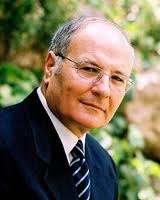 La France est en deuil et les drapeaux tricolores sont en berne. Les Français sont sous le choc, le terrorisme islamique a frappé Paris au cœur. Il a brisé les symboles inébranlables de la France. Il a assassiné la liberté de la presse et a tué les gardiens de la République. Cette terreur des fous d’Allah est effroyable car pour la première fois des journalistes ont été assassiné dans leur bureaux de rédaction, dans leur propre fief, devant leur ordinateur, face à leur dessin, leur créativité, leur œuvre courageuse. Auparavant, ils étaient pris en otage, puis décapités sur le champ de bataille, très loin de leur rédaction, et de leur famille. Aujourd’hui, dans la ville Lumière, des barbares ont voulu gommer des mots et des dessins par le sang des journalistes et des caricaturistes.
Today we are all "Charlie Hebdo"
By Beryl Wajsman on January 7, 2015
 The nightcrawlers have slithered out of their lairs once again in a brutal and barbarous attack on freedom butchering dozens in the offices of France's press icon of satire "Charlie Hebdo." The paper's "crime" was satirizing Islamists and Islamism. It had been firebombed in 2011 for republishing the Mohammed cartoons. Now, it is once again the duty of all free people to gather bold resolve and expose, denounce and destroy the vermin who perpetrate such horror so that we can rid our society of their pestilence. We can have victory over terror and we can have victory despite the terror. We can build communities of conscience that - together – will overcome the mightiest wellsprings of hatred and oppression. Because together people find courage. But we must all have the courage – even the audacity - to take the first step. Silence is not an option.
Denis Delaney 1933-2014
By Alan Hustak on December 26, 2014
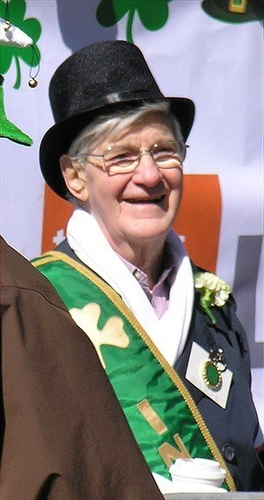 Denis Delaney was a free spirit an entertained and storyteller whose vivid imagination and homespun poetry celebrated the long since vanished Irish slum neighbourhood of Griffintown. A impish character in his own right, Delaney died Sunday, a week after his 81st birthday. “He was wonderful. He was Griffintown’s leading cheerleader,” said author Patricia Burns, who profiled Delaney in her book, The Shamrock and The Sheild. “He was such a loving, giving person, whose enthusiasm for the community was infectious. He used to write such wonderful stories, but Denis being Denis, you never knew where the truth began or ended.”
Canadian oil needs to decouple from the American market
By Robert M. Cutler on December 14, 2014
 U.S. President Barack Obama's appearance on The Colbert Report this week confirmed that he has no qualms about leaving Canada in the lurch in current global energy glut.
In the interview, Colbert observed that the Republican-controlled Congress would approve the Keystone pipeline, that polls show the American people favouring it, that the State Department review concluded any pollution would not be significant, and that it would create jobs for the U.S.workforce. In response to this "grilling", Obama repeated his long-stated misgivings about the project.
Boycott this!
By Beryl Wajsman on December 14, 2014
So, Concordia’s students have voted in favor of supporting an academic and investment boycott against Israel. The so-called BDS – boycott, divestment and sanctions – movement. ”So what?” you might say. Isn’t this the annual hypocritical regurgitation of the so-called “progressives?” Yes it is. And as always, it requires a response.
A response not because those involved don’t realize their own complicity in lies, but for those who are not so politically involved and may actually think there is legitimacy to this act. A response not to rewrite history, but to remind those involved that the demonization of the Jews is not new and is aligned with the darkest forces of human history.
The Concordia BDS experience When does anti-Zionism become anti-Semitism?
By Jonathan Mamane on December 14, 2014
 At the beginning of the semester a controversial anti-Israel referendum question was brought forward by the Concordia Student Union. As a result of the election, myself and numerous other anti-BDS Concordia undergraduate students, have been subjected to harassment, defamation, and public humiliation. In the short time period of the campaign, it was made evident that the initial purpose of the Israel boycott was an excuse for anti-Semitism.
Prior to the BDS campaign, the hostility between students was at an all time high. Opposition increased when CEO Andre-Marcel Baril formulated a question regarding the newly formed campaign. “Do you approve of the CSU supporting the Boycott,
Jean Béliveau: The greatness of grace and grit
By Beryl Wajsman on December 10, 2014
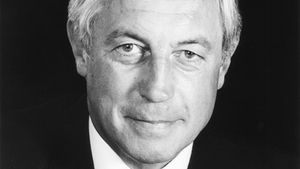 How many words are always written when greatness passes. Yet they are all necessary, as much for the living to continue, as to honor the departed. Because it becomes personal. And as much as any man, Jean Béliveau was personal to all of us.
The memories flood back of watching his fluidity and grace as young children sitting next to our parents. Following his career of greatness that was nearly unparalleled, his achievements were almost markers of our lives. For almost two decades, Hockey Night in Canada was Hockey Night with Béliveau as much as anything else.
Right in our own backyards
By Beryl Wajsman on December 8, 2014
At the time of the terrorist murders of WO Patrice Vincent and Cpl. Nathan Cirillo, we used this space to remind readers of the need for vigilance on the enemy within. That it was not sufficient just to commemorate the service and sacrifice of others. That all of us in our daily lives must be on guard against extremists hiding behind seemingly normal facades.
Among the reasons I wrote that editorial then was because I had actually been asked by someone, "is there really a threat from these groups in our own backyard?" And I was asked this exactly one day before the Vincent murder. Well there was a threat then, and there is now. Right in our own backyards.
Coercive rule and regulation killing Montreal business
By Robert Presser on December 8, 2014
Montreal’s problems reflected in Massimo Lecas’ view from Buonanotte’s head table
As a founding partner in Buonanotte on St. Laurent, one of Montreal’s best-known restaurants, Massimo Lecas is passionate about his business and his city. In conversation this week covering the challenges he faces as a restaurateur and his frustrations with Montreal’s dysfunctional layers of governance, his plight is emblematic of what ails Montreal’s retail, food and entertainment industries.
God Brings the House Down.
By Alan Hustak on December 6, 2014
 At first glance, The Book of Mormon which arrived at Place des Arts last week thanks to Evenko promotions is a send-up of a home grown, American made religion. But it is more than that. It is a refreshingly irreverent Broadway musical inspired by the gospel of South Park and at the same time it is also a subliminal meditation on faith and the awareness of the life of any lived religion. Behind the laughter it provokes is the nagging question:, what is faith and why do the faithful of any religion believe what they believe? The show addresses the hypocrisy of religious fundamentalism and lampoons the ability of people to cherry pick their beliefs. It is offensive as you might suspect.
Arrogant authority
By Beryl Wajsman on November 27, 2014
Two stories in the past week brought to light once again the problem of the arrogance of security authority. They are not strictly the types of stories that I have commented upon in the past. Those concerned mistreatment of visible minorities and the compromise of the basic tenets of due process and the rule of law. No, these stories - in certain aspects - could be termed almost routine, yet they still manifest the maladies that threaten our liberties and our lives. Worse yet, they hinder our progress to be truly just.
Abbas playing with fire on Temple Mount
By Jordan Turner on November 27, 2014
After relative calm for the last 10 years, terror has returned to the streets of Jerusalem. Palestinians have driven cars into women, children and newborns waiting for the train, and this week terrorists stormed into a Synagogue in a part of Jerusalem which is uncontestably part of Israel by every international standard, and murdered in cold blood four unarmed civilians in the midst of their early morning prayers. Israeli`s, who have been lulled into a false sense of security from years of calm now return to extreme vigilance and caution in their daily lives. As Israel wipes the blood off the ground they are left to ponder how the tension in Jerusalem has suddenly reached a fever pitch. It has nothing to do with Palestinian`s quality of life, employment, access to education or freedom of movement, it has everything to do with the access to the Temple Mount.
The Robillard Report: Courageous common sense
By Beryl Wajsman on November 27, 2014
Lucienne Robillard's report on cutting government spending and waste is the kind of courageous common sense that comes too rarely yet is so needed. Aside from the specifics, the importance of her work is that it highlights where the Quebec statist model can be cut without affecting the social security programs that we have all paid for during our working lives and which monies were supposed to be treated in trust. Indeed, it demonstrates that dramatic cuts are necessary if we are to keep our social contract viable and our credit worthiness stable.
Remembrance and War
By David T. Jones on November 27, 2014
 Washington,DC - There is a special mythos to ending a war on the “eleventh hour of the eleventh day of the eleventh month” that has clung to societal memories.
Some years it has been a grind-through-it event, when we were deeply engaged in other wars. One doubts that in the midst of World War II there was much attention paid to “Armistice Day” when the Great War had proved only a precursor to another greater one.
And during my boyhood, U.S. citizens were still celebrating “V-E” and “V-J” day proclaiming the victories in Europe and against Japan. “Armistice” Day had not yet morphed into “Veterans” Day.


